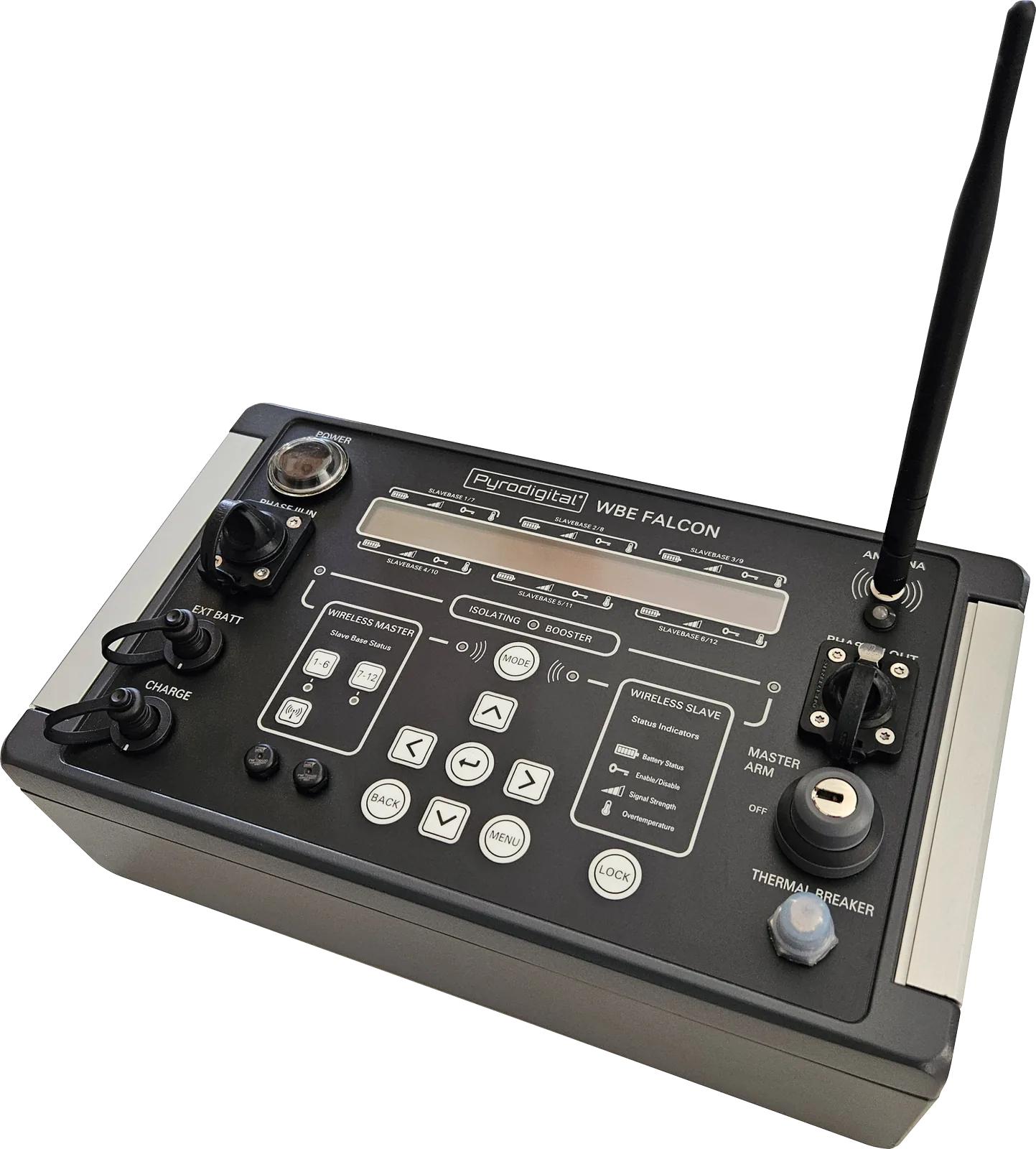
WB-E Falcon Wireless Base
A Wireless Connection within Your Pyrodigital Network
At a Glance
The WB-E Falcon Wireless Base provides a virtual cable connection between a Pyrodigital controller and its modules, enabling the controller to send firing commands and receive monitoring data. A wireless setup uses one Falcon base configured as the Master and up to 12 WB-E Falcon Wireless Bases configured as Remote Units. The same Falcon hardware can perform either role or operate as an isolating booster to power remote sections of the firing network.
Included Equipment
- WB-E Falcon Wireless Base
- 1 standard antenna
- 2 Safety Arm Keys
- Universal Charger with country-specific mains wall plug
- USB stick with Operating Instructions and FSK timecode files
- Spare fuses
Operational Role
A Falcon base can add a wireless link at any available network point in the Pyrodigital system, rather than only at the field controller. When configured as the Master, it receives the incoming network signal and communicates wirelessly with the Remote Falcon bases, which then power their local firing networks. The wireless link carries firing commands, continuity checking, and assignment scanning for the FC-A’s Advanced Mode.
The Falcon can also serve as an isolating booster. Its network input is galvanically isolated from the output network, allowing it to regenerate the incoming signal, add local network power, and provide electrical separation between network sections.
Continuity can be checked locally at a Falcon base without placing a field controller at that position. From the Master Falcon, operators can also monitor the status of each Remote Falcon, including signal strength, battery state, external power, temperature, and Safety Arm Key position.
For wireless security, each system uses a company-specific Customer ID together with a Network ID for the individual show. These help prevent unauthorized access and unintended control from another Falcon setup. The Falcon Wireless Base is approved for its intended use in the United States and Canada under FCC and ISED requirements; contact us for information about approval requirements and operating conditions in other countries.
The internal battery provides up to 46 hours of standby time or up to 16 hours of active operation with the network output powered and 40 FM-A modules connected. Actual runtime depends on the connected network. Contact us to confirm whether a compatible external power supply is available in your country for operating the Falcon from mains power.
System Compatibility
- Field controllers: FC-A, FC-E Raptor, and legacy Pyrodigital controller FC3
- Firing modules: FM-A and legacy Pyrodigital firing modules FM1 to FM8
- Accessories: Universal Case, Universal Charger, External Power Supply for WB-E Falcon, WB-E Falcon Antenna, Spare Keys
The case and external power supply are optional. - Network integration: Connects at available points throughout the PD Network; supports cable networks and combinations with Dragon and FiberCON
Manuals & Documentation
Technical Specifications
Wireless link
- Operating roles
- Master, Remote Unit or Isolating Booster; each role uses a WB-E Falcon Wireless Base
- Topology
- Point-to-point or point-to-multipoint
- Remote Falcon bases per Master
- Up to 12 WB-E Falcon Wireless Bases configured as Remote Units
- Rural line-of-sight range
- Up to 6 km (3.7 miles) with suitable Yagi antennas; dependent on the site, installation and radio conditions
- Urban line-of-sight range
- Up to 1.6 km (1 mile) with suitable Yagi antennas; dependent on the site, installation and radio conditions
- Supported wireless functions
- Firing commands, continuity checking and assignment scanning for FC-A Advanced Mode
- Remote Falcon base monitoring
- Signal strength, battery state, external power, temperature and Safety Arm Key state
Radio
- Frequency range
- ISM 902 to 928 MHz (United States FCC and Canada ISED)
- Modulation
- Gaussian Frequency Shift Keying (GFSK)
- Spreading
- Frequency Hopping Spread Spectrum (FHSS)
- Radio channels
- 6 selectable channels
- Transmitted power
- 30 dBm (1 W)
- Receiver sensitivity
- -106 dBm
- RF data rate
- 110 kb/s
- Antenna connector
- RP-SMA female, 50 ohm unbalanced
- Maximum input at antenna port
- 6 dBm
Security
- Encryption
- 256-bit AES with cipher block chaining (CBC)
- Customer ID
- 000000–999999; provides company-specific encryption for the Falcon network
- Network ID
- 0–32767; identifies a show network so Falcon bases with other Network IDs do not communicate with it
Pyrodigital network
- Network input
- 1, galvanically isolated from the output network
- Network output
- 1, with thermal circuit-breaker protection
- Output voltage
- 24 VDC nominal on the internal battery; dependent on the connected supply. Output powered when the Safety Arm Key is in armed position
- Network capacity on internal battery
- Up to 40 FM-A firing modules
- Maximum constant output current
- 3 A
- Isolating-booster function
- Regenerates the incoming network signal and provides local power; input isolated from the output network
- Local Check Status
- Continuity checking at the base itself, with no field controller at that position
Power
- Internal battery type
- Non-spillable Valve-Regulated Lead-Acid (VRLA)
- Internal battery voltage
- 24 VDC (2 x 12 VDC in series)
- Internal battery capacity
- 2.3 Ah
- Standby on internal battery
- Up to 46 hours
- Active operation with 40 FM-A
- Up to 16 hours on the internal battery with the network output powered
- Active operation with 40 legacy modules
- Up to 7.5 hours on the internal battery with the network output powered
- External power option
- Compatible External Power Supply for WB-E Falcon available separately in some countries
- Maximum charge current
- 0.56 A at <29.4 VDC
- External DC input
- 28 VDC
- Supplied charger
- Universal Charger, 100–240 VAC, 50–60 Hz, with country-specific mains wall plug
Environmental and physical
- Housing
- RF-shielded field enclosure
- Operating temperature (electronics)
- −20 °C to +85 °C
- Operating temperature (batteries)
- −20 °C to +55 °C